On-Premise vs. Cloud Call Centers: Which is Right for Your Dubai Business?
Thinking about setting up a call center in Dubai? You’re not alone – many UAE businesses wonder whether to go with an on-site communication hub (an on-premise system) or a cloud contact center. Both options have perks, and it can feel a bit techy to sort out. Don’t worry – we’ll break it down in plain English, with examples and local context so you can decide what fits your company. Along the way, we’ll point to helpful resources (like the TDRA rules and Avaya or Cisco solutions) and even show you where ArcNet can help. Let’s chat about the differences, pros, and cons!
On-Premise Call Centers (Your Own On-Site Hub)
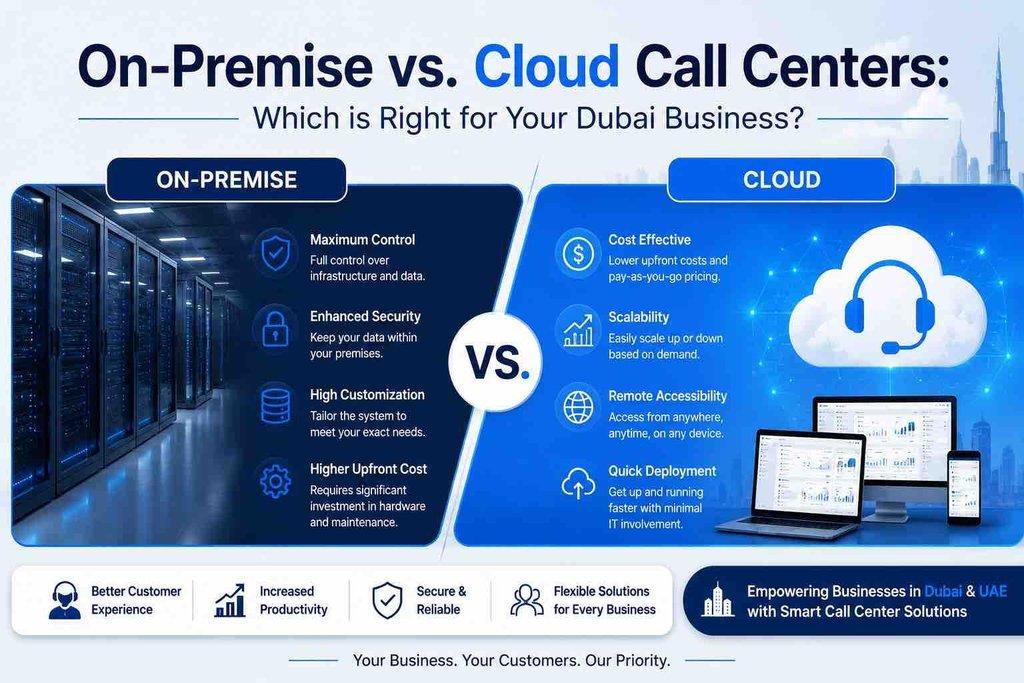
On-premise means all your call center gear lives in your office – servers, PBX hardware, phone system, everything. Think of it like hosting a mini-telecom in your building. You buy or lease the hardware (IP phones, a PBX box, maybe a server room) and put it on your floor. For example, one local guide notes: “On-premise (on-site) systems: you install servers and PBX hardware in your office. Upfront costs are higher (equipment, space), but you have full control and data stays on-site”arcnetuae.com. In simple terms, this is like owning a fancy kitchen: you pay more at the start, but you control every ingredient.
Good news: Because everything’s on-site, you own the equipment. You can customize the system fully (change settings, add languages, tweak routing) without asking an outside provider. Your customer data and call recordings stay in-house, which some businesses like for security or compliance. If you have strict data policies, this control can be reassuring. Also, traditional phone quality can be rock-solid since you’re just using local lines – there’s no funky Wi-Fi or internet hiccups to worry about (unless you use VoIP in-house, which we’ll cover).
Downsides: On-premise takes time and money to set up. Ultatel points out that building a classic call center with all the hardware and licenses “can take several months,” because you’re installing physical gear blog.ultatel.com. You’ll need space for racks and cooling, and possibly to hire or train IT staff to manage it. Maintenance falls on you too – if a hard drive crashes or a phone line goes down, you (or your vendor) must fix it. Scaling can be tricky: if you suddenly need 50 more agents, you might have to buy more phones or even a bigger PBX, which isn’t instant. In Dubai, that might mean ordering extra IP phones (brands like Avaya or Cisco are popular here and adding them to your network.
Finally, even on-premise centers in the UAE must follow local telecom rules. For example, the UAE’s TDRA says any public telecom service needs a license arcnetuae.com. So if your call center uses local phone numbers (from Etisalat or du), make sure you have the proper TDRA approvals arcnetuae.com. In short, on-premise is powerful if you want full control and have the budget for setup, but it’s a bigger upfront project.
Cloud Call Centers (Hosted Contact Centers)
Cloud contact centers flip the script: the software and servers live off-site, hosted by a provider. You connect over the internet. It’s like subscribing to a TV streaming service instead of buying a DVD collection. You log in via an app or IP phone, and the provider takes care of the heavy lifting. In Dubai, companies like Etisalat and du offer hosted voice or UCaaS plans. For example, one telecom blog notes that carriers here have “Hosted Voice” offerings with “low upfront cost in a ‘pay-as-you-grow’ model” arcnetuae.com.
Good news: Cloud is fast to start. You don’t have to install much hardware – often just some IP phones or softphones on computers. Ultatel explains that cloud setups have “minimal hardware requirements” and can be as simple as installing an app on your PC or phone blog.ultatel.com. Need more agents? You can usually add them in a few clicks (and pay more monthly) rather than buying new servers. This makes cloud easy to scale with your business. Remote work is natural, too: agents can log in from home or anywhere with internet.
Cloud systems also tend to have lots of features built in. Modern contact center platforms let you handle phone calls, chats, emails and even social messaging from one dashboard. For example, Avaya (a big contact center vendor) says their platform connects “customers wherever they are – phone, chat, email, [and] social” all from one interface arcnetuae.com. You get cool tools like interactive voice menus (IVR), call recording, analytics dashboards, and easy CRM integration out of the box. Plus, since the provider keeps the software up to date, you automatically get new features without manual upgrades.
Downsides: The big caveat is reliance on internet. Call quality depends on your connection, so you’ll want good bandwidth and maybe Quality of Service (QoS) settings on your router. Many Dubai setups pair their cloud phone service with SIP trunks or dedicated lines from Etisalat/du to keep voices clear arcnetuae.com. You’ll pay monthly fees (often per user), which can add up over time. And some companies worry about having customer data on someone else’s servers (though most cloud vendors use strong security). Also, check UAE rules here too: even if you host in the cloud, using UAE phone lines means you should comply with TDRA licensing arcnetuae.com.
In short, cloud call centers are great if you want to launch quickly and flexibly, especially with remote or growing teams. You trade some hardware control for ease-of-use and lower upfront spending.
Key Comparison Points
Let’s break down the on-prem vs. cloud differences side-by-side. These points can help you compare:
- Setup Speed: On-premise installations can take months (wiring offices, installing servers, etc.), whereas cloud systems can be ready in days by simply activating an account and adding phones blog.ultatel.comarcnetuae.com. Think of it like building a house (on-prem) versus renting an apartment (cloud).
- Costs: On-premise means big up-front costs – buying PBX hardware, servers, IP phones, and maybe paying for installation labor. Cloud shifts costs to monthly subscriptions (often pay-per-agent). You “rent” the system, so you might save upfront, but you keep paying monthly. Ultatel notes cloud has “no significant upfront installation costs but ongoing monthly subscription costs”blog.ultatel.com. The cloud’s pay-as-you-go can be cheaper for a small team, but if you run a call center long-term with many agents, on-premise might become cost-efficient after the initial build.
- Scalability: Need to add 10 agents next quarter? With cloud, it’s often a simple user management change. With on-prem, you may need new phone licenses or extra server capacity, which can be slower and more complicatedblog.ultatel.com. Cloud flexes easily; on-premise requires planning and upgrades.
- Control & Customization: On-premise wins on raw control. You own the hardware and data. You can customize dialing rules, call routing, security, etc., exactly how you want. In cloud models, you get a lot of settings too, but ultimate control rests with the provider’s platform. If your business handles super-sensitive data or needs a very custom setup, on-premise might be preferable.
- Reliability: On-premise systems often use traditional phone lines or dedicated SIP trunks, which can be very reliable and less affected by internet outages. Cloud call centers depend on internet – in Dubai’s well-connected landscape it’s usually fine, but you may need backup internet links (ArcNet suggests having a secondary connection)arcnetuae.com. Both require good network quality: cloud needs strong internet; on-premise still often uses VoIP or SIP trunks which need network stability.
- Features & Updates: Cloud platforms generally offer cutting-edge features like multi-channel chat integration, AI tools, and frequent updates without downtime. On-premise setups may need manual software updates or limit you to what the hardware can handle. For example, Cisco’s cloud contact center plans allow hybrid options and promise easy upgrades as part of their “Flex Plan”cisco.com. So if you want the latest bells-and-whistles with minimal hassle, cloud has an edge.
- Compliance & Security: Both models can be made secure, but responsibilities differ. With on-premise, you secure the hardware yourself (lock the server room, manage backups). With cloud, the vendor secures the servers, but you need to ensure the vendor meets UAE regulations. The TDRA (UAE’s telecom regulator) requires licenses for call center servicesarcnetuae.com, so either way you’ll work with a licensed telecom (Etisalat/du) to get official numbers and comply with rules (for example, you must not call numbers on the UAE Do-Not-Call list arcnetuae.com).
- Local Partners: One thing to consider in Dubai is available vendors. ArcNet and others work closely with brands like Avaya and Cisco, which support both on-prem and cloud solutions For example, ArcNet’s partners stock IP phones from Avaya and Cisco. This means whether you choose on-site or cloud, you can still use familiar top-brand hardware. Many local integrators even offer hybrid setups: an on-prem PBX with cloud features (so-called “Flex Plan” offerings cisco.com) that let you ease into the cloud over time.
Conclusion: Which is Right for Your Business?
In the end, there’s no one-size-fits-all answer. It depends on your business needs:
- If you value control and have the budget to invest upfront – say you’re a large enterprise or government agency with strict data rules – an on-premise call center might make sense. You’ll own the kit, have everything in-house, and avoid monthly fees. Just remember to plan for the space, staff, and licensing (TDRA will want to see all your ducks in a row)arcnetuae.comarcnetuae.com.
- If you prefer flexibility, fast deployment, and scalability, a cloud contact center is probably better. It’s especially great if your agents might work remotely or if you want to start small and grow. You won’t worry about servers breaking or firmware updates – the provider handles that. Just ensure your internet connection is solid, and choose a reliable telecom partner (Etisalat or du) for SIP trunksarcnetuae.com.
Many Dubai businesses find a middle ground. For example, you might use a local PBX for stability but connect it to a cloud-hosted contact center platform, getting the best of both worlds. Cisco even offers “Flex Plan” subscriptions where you mix on-premise and cloud as needed cisco.com.
No matter what you choose, partnering with a knowledgeable local integrator is key. ArcNet’s call center solutions page (see the placeholder link below) has examples of turnkey Dubai call center projects and mentions “quick deployment and cost-effective scalability” for exactly these scenarios. In fact, ArcNet and other local experts stress the importance of design: from proper cabling and QoS setup, to using quality phones from Avaya or Cisco.
Ready to decide? Consider your budget, how fast you need to launch, and how much control you want. And remember, regulatory compliance (TDRA, MoE rules, telecom licensing) is the same for both options. If you still feel unsure, check out ArcNet’s resources on call center solutions or chat with a local consultant. They can walk you through on-premise vs. cloud in Dubai’s context, with no heavy tech speak.