How to Set Up a Call Center in Dubai: A Step-by-Step Guide

Dubai’s fast-paced business environment rewards companies that stay connected with customers. A dedicated call center (aka contact center or communication hub) can be a game-changer for local businesses – from startups to hospitals, sales teams to government offices. It provides a streamlined support desk setup, helping you handle everything from customer inquiries to appointment scheduling. In Dubai and the UAE, good customer service often means multilingual support and 24/7 availability. By following this guide, you’ll learn how to build a call center setup in Dubai that fits your needs and complies with local rules.
- Startups & SMEs: In a growing business, a lean call center lets you field questions and process orders without hiring lots of extra staff. You can begin with a few agents on-site or even outsource inbound support.
- Healthcare Institutions: Hospitals and clinics use call centers to book appointments, answer patient questions, and provide telemedicine support. They need secure systems (HIPAA-like) and often bilingual staff for Dubai’s diverse population.
- Sales & Customer Service: Retailers and service companies rely on a contact center to follow up leads, handle complaints, and offer technical support. An efficient business phone system in Dubai ensures every call (or chat/email from social media) is answered promptly.
- Public Sector & Government: Government call centers (e.g. for utility services, visa info, public health) act as a citizen helpline. These centers require clear IVR menus and CRM integration so citizens can reach the right department easily.
Each of these sectors can benefit from a robust call center. Let’s walk through the steps to define objectives, choose technology, follow UAE regulations, and launch your support desk smoothly.
1. Define Your Call Center Objectives
Start by clarifying why you’re setting up the call center. Different goals lead to different setups. Will you focus on inbound support, outbound sales, or a blend (bi-directional)? For example, a clinic may need 24/7 patient support lines, while a startup may want agents making outbound calls to generate leads. Setting clear objectives ensures you pick the right tools and measures.
- Inbound vs. Outbound: Decide if agents handle mostly incoming calls (customer service, support desk queries) or outgoing calls (sales, surveys). Many businesses use a blended model.
- Key Metrics: Choose how you’ll measure success (e.g. average wait time, call abandonment rate, or sales conversion). Align these with your goals, whether it’s faster response times or higher lead conversion.
- Languages & Hours: Dubai is multicultural. Determine which languages are needed (Arabic, English, Hindi, etc.) and whether you need 24/7 coverage. An advanced IVR and skills-based routing can send callers to agents by language or department; local integrators note this ensures customers “reach the most qualified person available”arcnetuae.com.
- Industry Needs: Tailor objectives to your field. Healthcare call centers must prioritize privacy and accuracy; sales teams may prioritize quick first responses and follow-ups. Public sector lines might need record-keeping of all calls.
By defining your objectives upfront, you’ll know what to build: a simple support hotline, a full-fledged contact center installation UAE-style, or something in between.
2. Choose On-Premise or Cloud-Based System
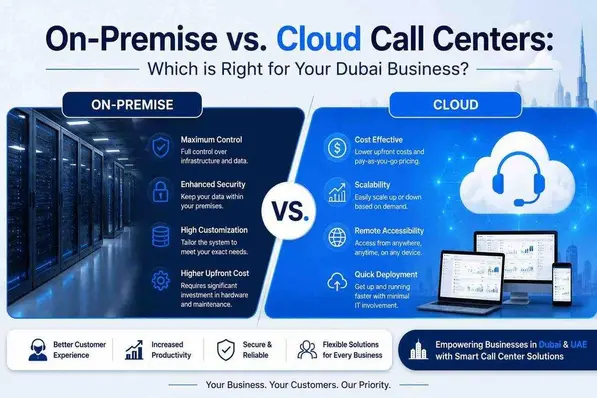
Next, pick on-premise (in-house) or cloud-based infrastructure for your call center. Each model has advantages:
- On-Premise (On-Site) Systems: You install servers and PBX hardware in your office. Upfront costs are higher (equipment, space), but you have full control and data stays on-site. For example, an on-site call center in Dubai might include a dedicated PBX rackroom. This is common if you need maximum customization or have security concerns. Local integrators like ArcNet can deploy and manage this infrastructure for you.
- Cloud-Based (Hosted) Systems: Providers host the call center platform off-site. You typically pay a monthly fee per user and use IP phones or softphones. Setup is faster and scales easily: add agents as you grow. Carriers in the UAE offer hosted voice. For instance, Du’s “Hosted Voice” plan highlights low upfront cost in a ‘pay-as-you-grow’ modeldu.ae. Cloud solutions also make remote work easy.
- Hybrid Approaches: Some companies use a mix – a local PBX with certain cloud services (like IVR or reporting) – to balance control and flexibility.
Regardless of choice, ensure your internet backbone is solid. VoIP and SIP trunking tie call quality to your network. ArcNet stresses the importance of Quality of Service (QoS): configuring your routers/switches so voice packets get priority will help guarantee “clear, uninterrupted calls over your Dubai-area Internet connection”arcnetuae.com. Both on-premise and cloud models often require SIP trunks or dedicated lines from Etisalat or du for reliable voice connectivity.
PRO TIP: Dubai’s telecom market has strong fiber coverage, so plan for backup connections (e.g., a secondary internet link). Also note, any call center (even cloud-based) that provides telecom services may trigger licensing requirements (see next step).
3. Pick the Right Technology (Hardware & Software)
With objectives and architecture set, focus on technology. This means picking your phones, networks, and call center software. Key components include:
- Phones & PBX Hardware: If you go on-site, you’ll install a PBX or IP-PBX system. This might be from Avaya, Cisco, Panasonic, Yeastar or NEC – all popular in UAE installations. In fact, local integrators note they work with “Panasonic, Yeastar, NEC, Avaya, and Cisco” PBX platforms to meet diverse needs arcnetuae.com. Choose IP desk phones or even softphones on PCs/mobiles. Ensure headsets are comfortable for agents.
- Network Equipment: Use reliable Ethernet switches, routers and ensure each IP phone has Power-over-Ethernet (PoE) if needed. Invest in a UPS (battery backup) so calls don’t drop during power blips. ArcNet advises enterprise-grade networking gear with features like PoE and built-in encryption to handle a busy call-center environment arcnetuae.com.
- Call Center Software: Install software for Automatic Call Distribution (ACD), IVR (Interactive Voice Response menus), and call recording. For example, set up multi-level IVR menus so callers can press numbers to reach the correct department. ArcNet’s engineers will program IVR trees and ACD queues so calls are routed based on skills (e.g. language or role).
- Customer Relationship Management (CRM): Integrate your phone system with CRM or ticketing software. This way, when a call comes in, the agent immediately sees the customer’s records (screen pop). ArcNet points out that CRM-phone integration “dramatically increases the productivity” of sales teams and helps hospitals and hotels “better serve the customer” by having patient or guest info readyarcnetuae.com.
- Omnichannel & Analytics: Modern platforms let you handle chat, email and social alongside voice. Avaya, for example, emphasizes connecting “customers wherever they are – phone, chat, email, [and] social – all from one platform” to provide seamless serviceavaya.com. Even if you start with voice, consider a system with easy add-ons for SMS or WhatsApp channels. Also set up reporting dashboards to track performance (call volumes, wait times, etc.).
- VoIP and UC Solutions: Most new setups use VoIP/UCaaS (cloud telephony) for flexibility. Etisalat notes VoIP’s big advantages: it cuts costs (cheaper long-distance calls) and adds mobility (your number isn’t tied to a desk)etisalat.Building connections that matter — discover how to set up a powerful call center in Dubai with the right technology, people, and local expertiseae. Features like call forwarding, call monitoring, voicemail-to-email, and per-second billing are often included. If you prefer cloud PBX, providers like Etisalat or du can supply UCaaS packages.
In short, shop for an integrated setup: a robust business phone system in Dubai usually includes enterprise IP phones, a server or cloud service, and network gear. Check that your chosen hardware/software is compatible with UAE telecom standards (for example, any imported equipment should be TDRA-approved).
4. Register with UAE Telecom Authorities
Before you “flip the switch,” ensure you comply with UAE regulations. The Telecommunications and Digital Government Regulatory Authority (TDRA) oversees telecom licenses. Under UAE law, operating any public telecommunications service requires a licensetdra.gov.ae. In practice, this means if your call center uses UAE phone lines or numbers, you must have the proper licensing or exemptions.
- TDRA License: Check if your call center activities require a telecommunications service license. As TDRA explains, providing telecom services (like voice calling infrastructure) needs official approvaltdra.gov.ae. This may involve applying online and paying fees. Even if you’re just using Etisalat/du lines, you should verify that your company and setup meet TDRA rules.
- Local Number Registration: UAE law mandates using locally issued numbers for business communications. If you run outbound marketing calls, make sure any phone numbers (landlines or mobiles) are registered under your company’s name and licensemoet.gov.ae. Unregistered or foreign numbers are not allowed for local dialing. Work with your carrier (Etisalat/du) to obtain a business trunk or toll-free number.
- Do Not Contact Registry: In 2024 the UAE introduced strict telemarketing rules. TDRA manages a “Do Not Contact Register” (DNCR) to protect consumers from unwanted callsmoet.gov.ae. If your call center will be making marketing or promotional calls, you must comply: avoid calling numbers on the DNCR and follow approved calling hours and scripts. This is especially important for outbound campaigns.
- Other Regulations: If you’re in free zones or certain industries (finance, healthcare), there may be additional permissions needed. For example, medical call centers might need Health Authority permissions for patient data. Always confirm with the relevant local authority.
In short, register early. Consult TDRA’s website to submit any necessary applications (usually via the UAE Pass portal). Linking with licensed telecom operators (du/Etisalat) early will ensure your lines are legal and won’t be cut off during setup.
5. Choose a Trusted Local Installer
Even if you know what you want, it pays to hire a local expert. Dubai has several ICT integrators who specialize in call centers. A good installer will have hands-on experience and can guide you through local peculiarities. For example, ArcNet is a Dubai-based IT integrator that “delivers complete on-site call center installations,” providing enterprise-grade PBX systems, IP phones, and structured cablingarcnetuae.com.
- Local Expertise: Look for a vendor familiar with Dubai’s market. They’ll understand regional business etiquette (like greeting callers in both Arabic and English) and can recommend UAE-tested hardware. ArcNet’s website, for instance, highlights various industries they serve (e-commerce, healthcare, finance, etc.) and shows they handle the full installation process.
- Vendor Partnerships: Choose installers partnered with major brands (Avaya, Cisco, Panasonic) and with local carriers. This ensures they can get genuine equipment and service plans. Check if they offer service agreements (SLA) for support.
- Consultation & References: A professional installer will help refine your plan. They should audit your space, network, and requirements. Ask for case studies or references. (ArcNet, for example, has a portfolio of Dubai call center projects.)
- ArcNet Example: As an example, ArcNet’s call center solutions page outlines turnkey services – from telco cabling to software setup. It mentions “quick deployment and cost-effective scalability,” meaning they build systems that can grow as your team growsarcnetuae.com. You might say to your readers: "See [ArcNet’s call center solutions page] for an example of such services."
Finding the right partner can save time and headaches. They’ll handle tricky parts (like setting up VoIP gateways or CRM integration) and often offer training. In short, choose a trusted installer who knows the UAE telecom environment and can support you long-term.
6. Staff Training & Launch
Once the hardware and software are in place, prepare your team. A new call center needs well-trained agents to succeed.
- Technical Training: Teach your agents how to use the system: handling calls on the IP phones, transferring calls, using any software (CRM screens, call-logging tools). If you installed new ACD/IVR menus, make sure supervisors know how to manage them.
- Product & Process Training: Agents need up-to-date info on your products/services and clear procedures for handling calls. Role-play common scenarios (billing questions, complaints, technical support). For healthcare, include patient privacy guidelines; for sales, maybe pitch techniques.
- Soft Skills: Emphasize customer service etiquette. In Dubai’s culture, politeness and patience are crucial. Provide scripts or guidelines, especially for greetings and closings, in all needed languages. Since Dubai is multicultural, training agents in both English and Arabic greetings (and having bilingual staff) can make a big difference.
- Pilot Runs: Before full launch, do a soft launch or pilot. Take a limited number of calls to test the system. Collect feedback: are call queues set right? Does IVR flow work? Are recordings and reports working? Fix any issues.
- Go Live: When you’re confident everything runs smoothly, switch on your service officially. Announce your new support hotline or contact center through marketing channels or internal comms. Monitor the initial calls closely and continue to refine processes.
A well-trained team will make your call center thrive. Encourage feedback and continuous learning (e.g. weekly team reviews). Remember, a call center is as much about people as it is about technology.
By following these steps—defining objectives, choosing the right infrastructure and technology, complying with UAE regulations, and training your staff—you’ll establish a solid on-site call center in Dubai or a modern cloud-based contact center for your UAE business. Good communication is a key competitive advantage in Dubai’s market, so a properly set-up call center will help you build customer trust and grow your organization.